
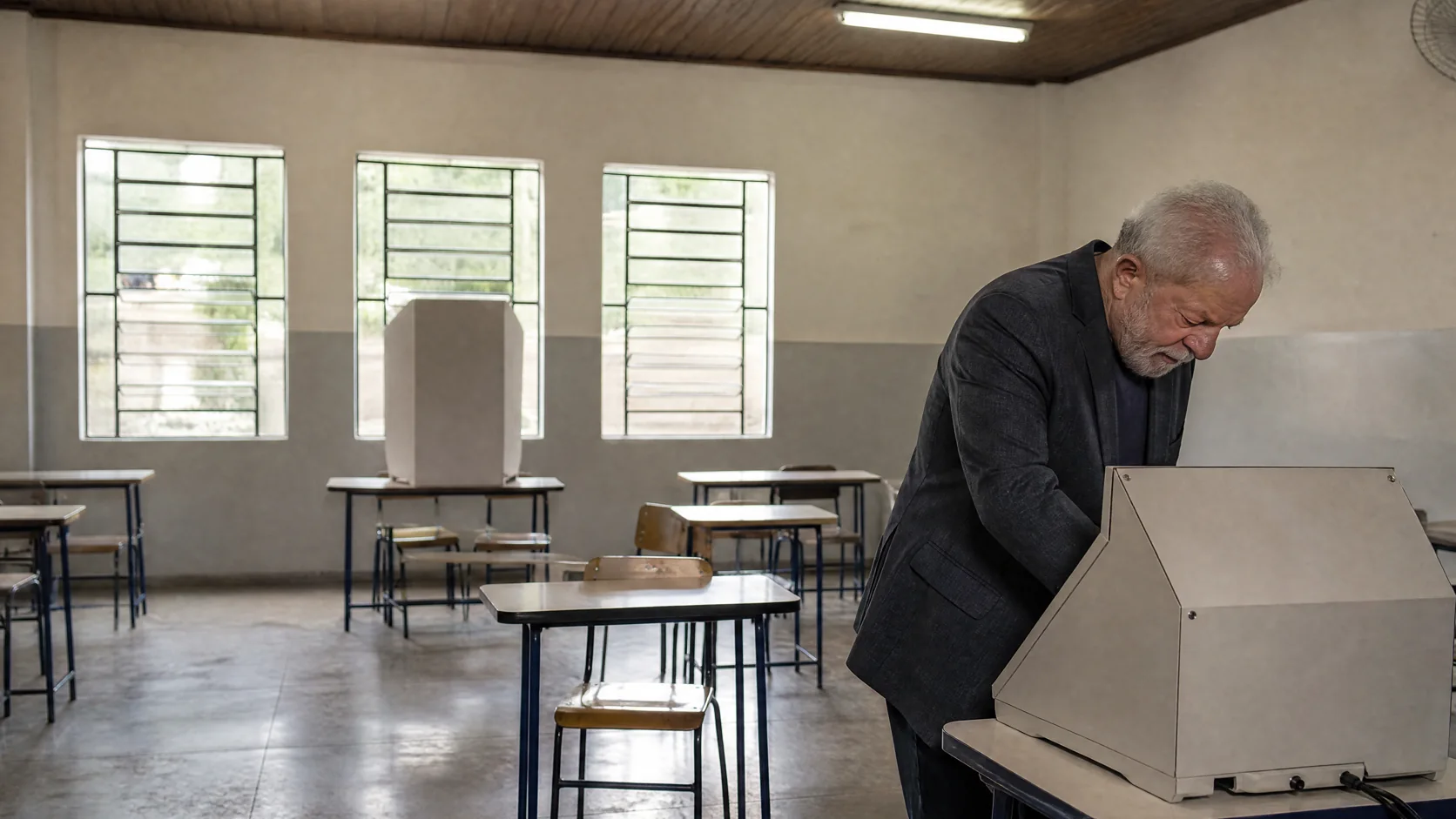



Brazil Presidential Runoff 2026 Result: Lula Wins 51.79% to 48.21%
Lula won Brazil's 25 October 2026 runoff with 51.79% of valid votes to Flávio Bolsonaro's 48.21% on the TSE count. The margin, turnout and the next steps.
versus Editorial · 17 October 2026
Lula has won Brazil's presidential runoff of Sunday 25 October 2026 by 4,430,191 votes: the Superior Electoral Court (TSE) counted 64,256,232 for him (51.79% of valid votes) and 59,826,041 for Flávio Bolsonaro (48.21%), with all 499,248 polling sections in. When we checked at 06:07 GMT on Monday 26 October, versus showed all seven predictions in this guide as settled, including the one on who wins and by how much.
The TSE's results page marks Lula as elected, and the court's president, Kassio Nunes Marques, announced the re-election on the night of the vote. Lula, president since 1 January 2023, starts a new four-year term on Tuesday 5 January 2027. This guide is for readers in Great Britain, where the clocks went back to GMT on 25 October.
The final count, line by line
These figures come from the TSE's results site, which we last read at 06:08 GMT on 26 October. Its page for the presidential runoff was last updated at 23:26:38 Brasília time on 25 October (02:26 GMT on 26 October) and showed 100% of sections counted.
- Lula (Workers' Party, PT): 64,256,232 votes, 51.79% of valid votes, marked elected.
- Flávio Bolsonaro (Liberal Party, PL): 59,826,041 votes, 48.21%, marked not elected.
- Turnout: 128,236,074 ballots from 158,745,502 registered voters, or 80.78%. The TSE records 30,509,005 abstentions (19.22%), plus 423 voters registered at sections that were not set up.
- Blank and null ballots: 1,430,496 blank (1.12% of ballots) and 2,723,305 null (2.12%), leaving 124,082,273 valid votes, 96.76% of the total.
Blank and null ballots help neither candidate: article 77 of the Constitution hands the runoff to whoever takes a majority of valid votes. Worked out from the vote counts, Lula's margin is 3.57 percentage points. The TSE's news item on the result, published at 00:18 Brasília time on 26 October (03:18 GMT), gives the same totals and puts abstention at about 19.2%, down from 21.08% in the first round.
How the runoff compares with round one and the polls
The order of 4 October was reversed. In the first round the TSE counted 56,104,503 votes for Flávio Bolsonaro (47.03% of valid votes) and 53,879,538 for Lula (45.16%), on a turnout of 78.92%. With neither above half of the valid votes, the top two met again on the last Sunday of October, as article 77 provides.
The final Datafolha and Quaest polls, both in the field on 23 and 24 October with margins of error of 2 points, put Flávio Bolsonaro on 51% of valid votes and Lula on 49% (Globo's reports of the Datafolha and Quaest polls, published on 24 October). No versus prediction settles on a poll.
Why voting ran past 17:00 in some places
Voting was due to run from 08:00 to 17:00 Brasília time (11:00 to 20:00 GMT) in all 26 states and the Federal District at once, the TSE said on 24 October. On the day, an interim ruling by Justice Cristiano Zanin of the Federal Supreme Court (STF) extended voting to 19:00 (22:00 GMT) at sections still open. In a note at 18:44 Brasília time (21:44 GMT), the TSE said voting went on only where it had not closed by 17:00, and that receiving ballot box reports, counting and publishing results would resume after 19:00. Its president later said the pause had left a backlog of reports waiting to be processed.
How the versus predictions settled
When we checked at 06:07 GMT on 26 October, versus showed its winner and margin prediction as settled. Its eight answers each pair one of the two candidates with a band for the winning margin: below 4 points, from 4 to 8, 8 to 12, or 12 and above. The margin is the gap in percentage points between the two shares of the valid vote, so blank and null ballots play no part, and a margin landing exactly on a dividing line goes to the band above. The yardstick is the TSE's official count once final; consistent reports from credible outlets can decide the result, with the TSE's published figures settling any doubt. Lula's 3.57-point margin can be set against those bands.
Five Yes or No predictions split turnout into bands: below 76%, 76% to 78%, 78% to 80%, 80% to 82% and 82% or more. Each divides every ballot cast, blank and null ones included, by all registered voters, using the TSE's official second-round figures, and a figure exactly on a line goes to the higher band. On the TSE's count that is 128,236,074 out of 158,745,502, or 80.78%. All five showed as settled at 06:07 GMT.
All six had the same end date, 03:59 GMT on 26 October, and a long stop in case no definite figure existed by 23:59 New York time on 30 June 2027 (04:59 BST on 1 July 2027): every margin answer would then have settled No, and turnout would have counted as below 76%. The debate prediction, which asked whether Lula and Flávio Bolsonaro would meet in a live TV debate by 24 October, had its end date at 23:59 BST on 18 October and is settled too. What market resolution means explains the process in general.
What happens before 5 January 2027
- By Friday 18 December 2026: diplomação, the formal certificate of election. The TSE's election calendar makes 18 December the last day for issuing it to everyone elected this year; for the presidency, the Electoral Code gives the national count and the proclamation of the winner to the TSE.
- Tuesday 5 January 2027: the new term begins. Article 82 of the Constitution, as changed by Constitutional Amendment No. 111 of 2021, starts the four-year term on 5 January of the year after the election, and article 78 has the president take the oath at a session of Congress. The amendment says the term that began on 1 January 2023 lasts until that day.
Before you trade
You can lose the whole amount you put into a position. A 2% transaction fee is added on top of the stake and shown before you confirm, you can sell at the current price while a prediction is open, and your loss can never exceed what you put in. versus is licensed by the UK Gambling Commission under account 101143 (public register), and Safer Play has deposit limits, loss limits, reality checks, time out and self exclusion, alongside GAMSTOP.
Frequently asked questions
Who won Brazil's 2026 presidential runoff?
Lula, with 51.79% of valid votes to 48.21% for Flávio Bolsonaro on 25 October 2026, on the TSE's count with every polling section in. The TSE's results page marks him as elected.
How big was Lula's winning margin?
4,430,191 votes, or 3.57 percentage points of the 124,082,273 valid votes.
What was the turnout in Brazil's runoff?
80.78%: 128,236,074 of the 158,745,502 registered voters cast a ballot, up from 78.92% in the first round on 4 October.
When does Lula's new term begin?
On Tuesday 5 January 2027, at a session of Congress. A 2021 constitutional amendment moved the start of the presidential term from 1 January to 5 January, beginning with this election.
18+ only. Trade responsibly. BeGambleAware.org and GAMSTOP.
Predict the world’s next moves.
enter versus™More frompulse

US House Races 2026: What Eight District Predictions Ask
30 October 2026

Taiwan Local Elections 2026: Mayoral Candidates and UK Poll Times
30 October 2026

Godzilla Minus Zero Rotten Tomatoes Score: The 9 November Reading
30 October 2026
US CPI Report for October 2026: 10 November UK Time and Predictions
29 October 2026

When Will Prabowo Stop Being Indonesia's President? Term and Rules
29 October 2026

Bulgaria Presidential Election 2026: Iotova Faces Gyurov in a Runoff
27 October 2026